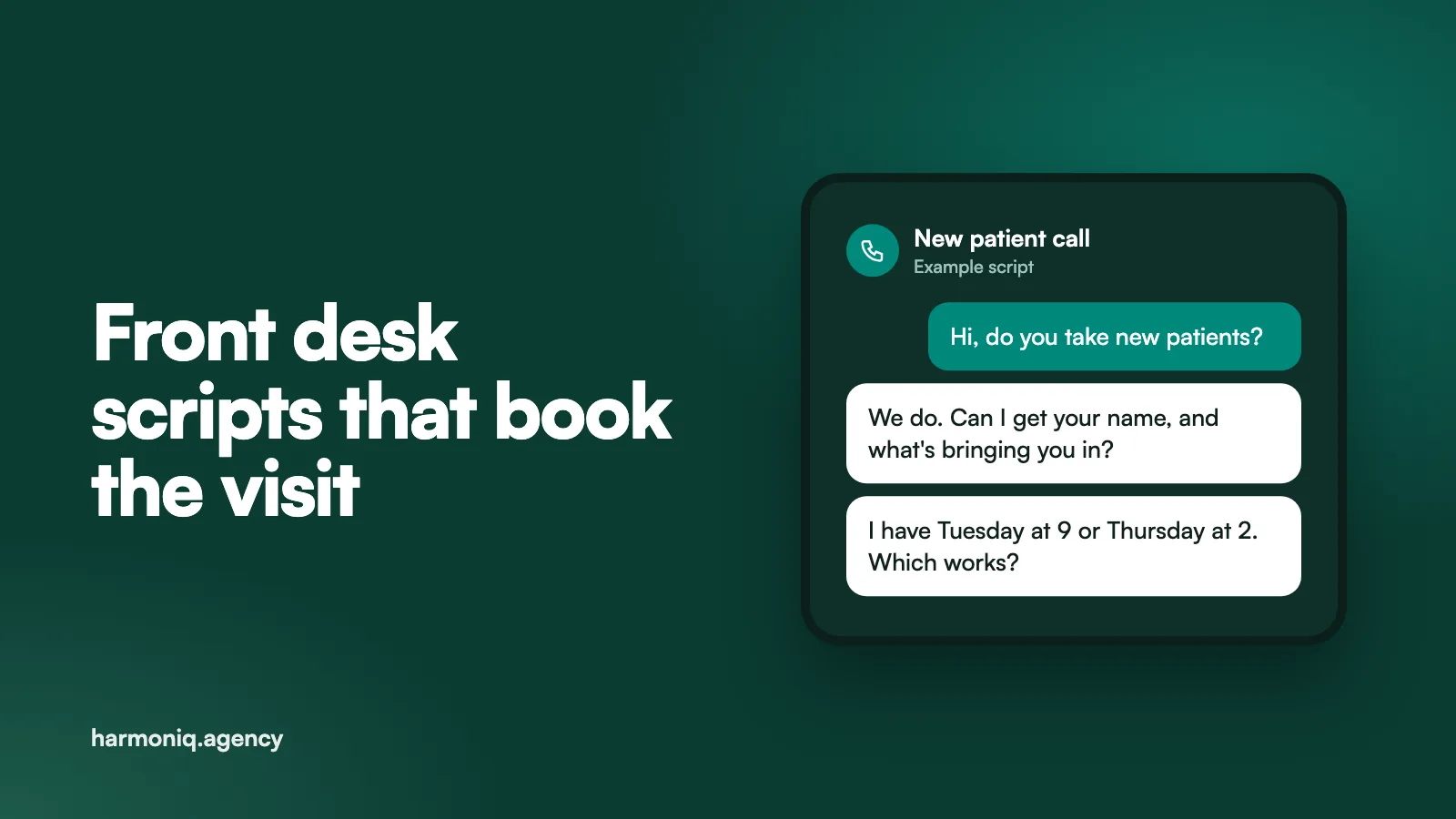
Dental Front Desk Call Scripts That Book the Visit
A caller who hangs up without a time on the calendar is free to call the next office on the list. Most of what fills a schedule happens in those few minutes on the phone.
Patient Prism, a call-tracking vendor, analyzed 11.5 million patient calls to 8,280 dental locations in 2025 for its Dental Patient Access Report. Of every 100 calls, 31 hung up before reaching a person and 21 booked an appointment. That is a vendor's own research, so treat it as a rough guide. Your call log will tell you your number.
Below: why calls end without a booking, seven scripts you can print today, and how to tell whether they are working.
Why do calls end without a booking?
Most callers ask one question. The desk answers it. The call ends.
That looks like good service, and it loses the visit. The question a caller asks is usually standing in for a worry. "How much is a cleaning?" often means "Can I afford to come in?" "Do you take Delta?" often means "Will this be a surprise bill?" Answer only the words and you have given the caller what they need to hang up and compare.
Three patterns show up again and again:
- No time is offered. The caller gets an answer and a "feel free to call back." Nobody suggests a day.
- Paperwork comes before help. The desk asks for date of birth and member ID before the caller has said what is wrong.
- Every person answers differently. One person quotes a fee, another says "it depends," a third transfers to the office manager. The patient's experience depends on who picked up.
All three come from the system. Nobody has written down what the practice says, so each person fills the gap their own way. A script gives the whole team one answer to work from.
One rule sits under every script below: end with two specific times. "Would Tuesday at 10 or Thursday at 3 work better?" is easier to answer than "When would you like to come in?"
What do we say to a first-time caller?
The goal is to find out why they called and get them on the calendar inside one call. Insurance details can wait until the end.
Answer: "Thanks for calling [Practice], this is [Name]. How can I help you today?"
Find the reason: "Are you looking for a regular checkup, or is something bothering you?"
Get their name early: "Can I get your first name? Thanks, [Name]."
Offer times: "We have a new-patient visit Tuesday at 10 or Thursday at 3. Which works better?"
Then the details: "Great. I'll just need your full name, date of birth, phone, and your insurance if you have it."
Close: "You're set for [day, time]. I'll text you the address and a short form so you're not filling it out in the lobby."
Avoid: starting with "Do you have insurance?", listing every service the practice offers, or ending with "Give us a call when you're ready."
How do we answer "how much is it?" without quoting a price?
Many price callers have no insurance and are deciding whether they can come in at all.
If your practice has set a fee for a new-patient exam and cleaning, say it plainly. A clear number builds trust. If the practice has not set one, never invent a figure on the phone. Explain what the price depends on, then offer the visit that answers it.
Explain what it depends on: "Good question. It depends on what the doctor finds, so I'd rather not guess."
Say what the first visit does: "The first visit is [what your first visit includes]. Before any treatment, we go over the options and the cost with you, and nothing happens until you say yes."
Ask one question: "Is this for a checkup, or is something specific bothering you?"
Offer times: "I have Wednesday at 9 or Friday at 1. Want me to hold one?"
Avoid: "It depends" on its own, a long list of fees, or putting the caller on hold to find someone who knows.
"Do you take my insurance?"
This is the call most likely to end in "OK, thanks" and a hang-up. The fix is to ask which plan before answering, then give the honest version of yes.
Ask first: "Happy to check. Which insurance do you have?"
If in network: "Yes, we're in network with [Plan]. Let's get you scheduled and we'll check your benefits before the visit."
If out of network: "We're out of network with [Plan]. Some plans still pay part of the visit. We file the claim for you, and we'll check what yours covers before you come in."
If you are not sure: "Let me check that for you. Can I call you back by [time] today? What's the best number?"
Then offer times, either way.
Only use the out-of-network line if your office files those claims. Avoid: "We don't take that" with nothing after it, explaining annual maximums over the phone, or "We accept all insurance" unless it is true.
What do we say when someone calls in pain?
Someone in pain usually books with whoever can see them soonest. Get the time on the calendar first and the paperwork second.
Show you heard them: "I'm sorry, that sounds painful. Let's get you in."
Three quick questions: "Where does it hurt? Is there any swelling? Any trouble breathing or swallowing?"
If breathing or swallowing is hard: "That needs emergency care right now. Please call 911 or go to the nearest emergency room."
Otherwise, offer the soonest time: "The doctor can see you today at [time]. Can you make that?"
Details after: "Great. I'll just need your name and number, and we'll handle the rest when you get here."
Write down, with your doctor, what counts as a same-day visit and who decides. Keep the 911 line in every version of this script. MedlinePlus, on a fast-spreading infection under the tongue, says breathing difficulty is an emergency and to go to the ER or call 911 right away.
Avoid: "Our first opening is in three weeks," asking for insurance before asking where it hurts, or giving medical advice the doctor has not approved.
How do we handle a cancel or reschedule call?
A cancellation without a new time is how a patient drifts off your schedule. The script keeps the visit on the calendar, even if it moves.
Make it easy: "No problem, thanks for letting us know."
Offer a new time: "Let's find you a new time now so you don't lose your spot. I have [day, time] or [day, time]."
If they can't pick: "Would it help if I pencil in [day] and text you? You can change it any time."
Save the cancellation policy for the second late cancel, and say it kindly. Avoid: "OK, I'll cancel that. Call us when you're ready." Patients who leave without a next visit end up on your recall list, and our recall guide covers how to bring them back.
What do we do after a missed call?
A missed call is a caller who has not decided yet. Return it within the hour. The longer it waits, the more likely they have called someone else.
The callback:
"Hi, this is [Name] from [Practice]. We missed a call from this number a little while ago and I wanted to make sure we helped you. What can I do for you?"
The voicemail. Keep it under 20 seconds:
"Hi, this is [Name] at [Practice], returning your call. You can call us back at [number], or reply to the text I'm sending now."
The text. Send it right after the voicemail:
"Hi, this is [Name] at [Practice]. Sorry we missed your call. How can we help? Reply here or call [number]. If you'd like a visit, we have [day] at [time] open."
Decide who owns callbacks on each shift. "Whoever is free" usually means nobody.
What do we say when a patient says "let me think about it" at checkout?
"Let me think about it" usually means one thing is unclear: cost, timing, or worry about the treatment itself. Ask which one.
Accept it: "Of course. Take the time you need."
Ask one question: "Is it the cost, the timing, or something about the treatment you'd like to understand better?"
If cost: "Let me show you [the payment options your office offers] before you go."
If timing: "Let's hold a time a few weeks out. If it doesn't work, you can move it."
If unsure about the treatment: "Would it help to have the doctor call you, or to come back for a short visit to go over it again?"
Set the follow-up: "I'll call you on [day] to see where you landed. Is this the best number?"
Avoid: "Just call us when you're ready." Without a date, nobody follows up and the plan sits open in your software. Our case acceptance fix is built around closing that list.
How do we know the scripts are working?
Count three numbers every week. All of them come from your phone system's call log, matched against your practice software.
- New-patient calls answered. Your call log shows every inbound call. Tag new-patient calls by hand for two weeks if your system cannot, or count calls from numbers not in your patient list.
- Calls that end in a booking. Compare new-patient calls in the log with new-patient appointments created that week in Open Dental or your practice software. The gap is the leak.
- Missed calls returned within an hour. The call log has the time of every missed call and every outbound call. Line them up.
Listening is the fourth step, and it only works if your system keeps recordings or transcripts. Check whether yours does, and on which plan. Pull five calls a month that did not book, play them for the team, and change the script where callers got stuck.
Start this week. Print the scripts, put them next to the phone, and count the three numbers for seven days.
Where Harmoniq fits
These scripts are a starting point. The best ones are written from your own calls, because your callers ask your questions. Our Phone and front desk fix reads 30 to 90 days of your call log, sorts who calls and why, and rebuilds the scripts, callback routine and phone settings with your team. We fix systems, not people. To see what missed calls cost you, the free Lost Revenue Calculator takes about three minutes. If you want every leak in dollars, the Lost Revenue Report reads phones alongside treatment, recall and insurance.
Hear your own phones first
The free Practice Review includes two test calls to your office as a new patient, one in office hours and one at lunch. You get one page and a 30-minute call. Book a free Practice Review.